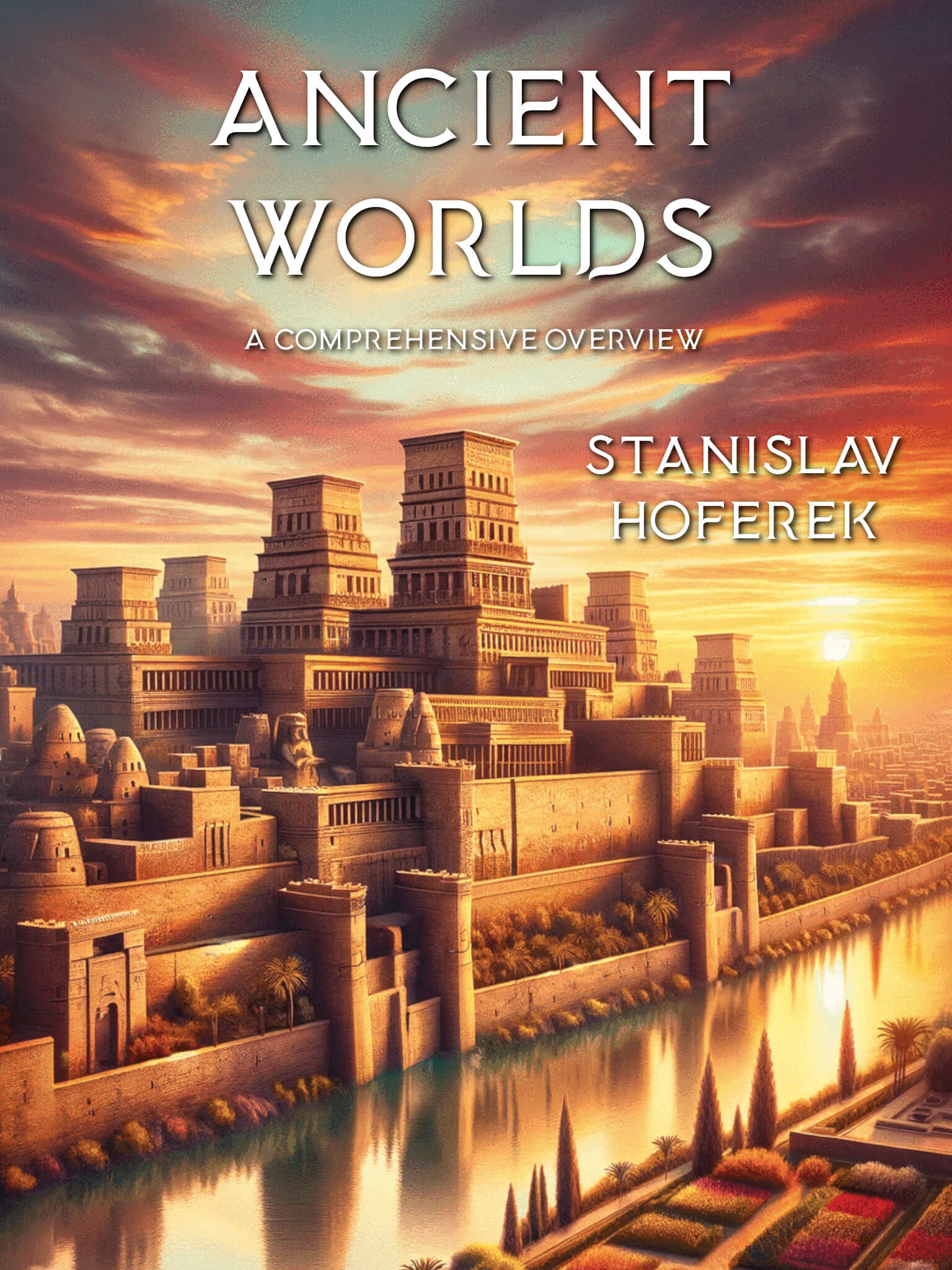
A Comprehensive Overview
Author |
Publisher |
License |
Edition |
Book cover |
Embark on a journey through time with "Ancient Worlds: A Comprehensive Overview". Delve into the rich tapestry of ancient history, spanning the rise and fall of mighty empires, the flourishing of vibrant cultures, and the enduring legacies of the past. From the majestic pyramids of Egypt to the grandeur of the Roman Empire, this comprehensive volume offers a captivating exploration of the ancient world. Featuring meticulously researched content, vivid illustrations, and engaging narratives, "Ancient Worlds" brings to life the triumphs, struggles, and innovations of humanity's earliest civilizations. This book is an indispensable guide to understanding the foundations of our shared human heritage.
Discover the transition from prehistory to recorded history, when the advent of writing systems enabled civilizations to document their achievements and aspirations.
Contents
Prequel: Introduction to the Ancient World 4
Chapter I: Rivers of the Ancient World 6
Chapter II: Ancient Cultures and the Impact of Adversities 8
Chapter III: Agriculture, Harvests, and Food Storage 10
Chapter IV: Ancient Era Superpowers 11
Chapter V: From Simple Faith to Complex Religions 19
Chapter VI: From Barter to Banking in the Ancient World 20
Chapter VII: Warriors and Tacticians 21
Chapter VIII: Milestones of Ancient History 23
Epilogue: The Early Middle Ages and the Dawn of a New Era 24
The term "ancient times" refers to a pivotal period in human history characterized by the emergence of early civilizations, the development of complex societies, and the establishment of foundational institutions and cultural traditions. It is a time when humanity transitioned from hunter-gatherer lifestyles to settled agricultural communities, laying the groundwork for the rise of the great civilizations of antiquity.
Many ancient civilizations, including those of Mesopotamia, Egypt, Greece, and Rome, were built on systems of slavery. Slaves were integral to the functioning of these societies, performing essential labor in agriculture, construction, and domestic service. Despite their contributions, slaves were often subjected to harsh conditions and denied basic rights, highlighting the inherent inequalities and injustices of ancient society.
The concept of "ancient times" varies across different regions of the world, reflecting the diverse historical trajectories of human civilizations. In Western historiography, the ancient era is typically considered to begin with the rise of the earliest civilizations in Mesopotamia and Egypt around 3100 BCE and to end with the fall of the Western Roman Empire in 476 CE. However, in other parts of the world, such as East Asia and the Americas, the ancient era may have different chronological boundaries based on the development of indigenous cultures and civilizations.
Communication and exchange of knowledge between different regions of the world varied greatly during ancient times. While some ancient civilizations, such as those of Egypt, Mesopotamia, Greece, and Rome, had extensive trade networks and diplomatic relations with neighboring states, others remained relatively isolated due to geographical barriers or cultural differences. Nevertheless, there were instances of cross-cultural interactions, facilitated by trade routes like the Silk Road, which connected East and West and facilitated the exchange of goods, ideas, and technologies.
Over the course of approximately 3500 years, life in certain parts of the world underwent dramatic transformations. New tools, societal structures, military and tax systems, educational practices, and cultural norms emerged, shaping the course of human history. Civilizations rose and fell, leaving behind legacies that continue to influence the modern world. However, in some regions, the changes were more gradual and incremental. Traditional ways of life persisted for centuries, with societies adapting slowly to external influences or internal developments. These regions may have experienced less dramatic shifts in technology, governance, or social organization, maintaining a degree of continuity with their ancient past.
During ancient times, significant strides were made in metallurgy, particularly in the development of copper, bronze, and iron tools. The discovery and mastery of metallurgical techniques revolutionized ancient societies, enabling them to create stronger, more durable tools and weapons. Copper, one of the earliest metals to be utilized by humans, was initially used in its pure form for tools and ornaments. However, the introduction of bronze—a copper-tin alloy—around 3300 BCE ushered in a new era of technological innovation. Bronze tools and weapons were harder and more resistant to corrosion than their copper counterparts, offering ancient civilizations a significant advantage in agriculture, construction, and warfare. Later, around 1200 BCE, the widespread adoption of iron tools marked another major breakthrough. Iron, though more difficult to smelt and shape than bronze, was abundant and offered superior strength and versatility. The transition from bronze to iron tools transformed ancient societies, facilitating the expansion of empires and the development of complex civilizations.
In tandem with advancements in metallurgy, ancient civilizations also made significant progress in seafaring. From the Nile River in Egypt to the Aegean Sea in Greece and the Mediterranean in Rome, maritime trade played a crucial role in connecting distant regions and fostering cultural exchange. Innovations in shipbuilding, navigation, and maritime technology allowed ancient sailors to venture further from their shores, exploring new territories, establishing trade routes, and facilitating the exchange of goods, ideas, and cultural practices. The Phoenicians, renowned seafarers of the ancient world, were particularly influential in advancing maritime trade and exploration, establishing colonies and trading posts throughout the Mediterranean and beyond. Their legacy lives on in the annals of history, highlighting the importance of seafaring in the development of ancient civilizations and the interconnectedness of the ancient world.
In summary, the ancient world was a dynamic and diverse tapestry of civilizations, characterized by the emergence of complex societies, the institution of slavery, and varying levels of global awareness and interaction. Understanding the complexities and nuances of ancient times is essential for comprehending the foundations of modern civilization and the enduring legacies of the past.
In the ancient world, rivers were not merely geographical features; they were the lifeblood of civilization. From the Nile in Egypt to the Yellow River in China, these mighty waterways sustained the growth and prosperity of ancient societies. This article explores the significance of several great rivers of antiquity and their role in shaping the course of human history.
The Nile River, stretching over 4,100 miles through Egypt, was the cradle of one of the world's earliest civilizations. Its annual floods deposited nutrient-rich silt on the surrounding land, facilitating bountiful harvests and supporting a thriving agricultural economy. The Nile also served as a vital transportation route, enabling trade and communication between distant regions. From the majestic pyramids of Giza to the bustling city of Alexandria, the Nile shaped every aspect of ancient Egyptian life.
The Yellow River, often called the "Mother River" in Chinese culture, was vital to ancient China's development. Its floods, though unpredictable, fertilized the land, supporting agriculture and dense populations. Despite challenges, it facilitated trade and cultural exchange. The Yangtze River, known as the "Long River," played a similar role. Stretching over 3,900 miles, it sustained urban centers like Chengdu and Wuhan and divided China into north and south. Both the Yellow and Yangtze Rivers were integral to ancient China's prosperity. In Southeast Asia, the Mekong River served as a lifeline for civilizations like the Khmer Empire. Its fertile delta supported agriculture and trade, while its waters facilitated communication and transportation across the region.
The Ganges and Indus Rivers, alongside other significant waterways in India, have played pivotal roles in shaping the landscape and culture of the Indian subcontinent. The Ganges, revered by Hindus, flows over 1,500 miles from the Himalayas to the Bay of Bengal, supporting agriculture and sustaining ancient cities like Varanasi. The Indus, one of Asia's longest rivers, facilitated the growth of the Indus Valley Civilization, with cities like Mohenjo-Daro showcasing advanced urban planning. Other important rivers include the Brahmaputra, Godavari, and Yamuna, each contributing to agriculture and sustaining ecosystems across the region.
The Danube River, stretching over 1,770 miles, served as a natural boundary and a strategic thoroughfare for empires such as the Roman and Byzantine Empires. It connected the Mediterranean Sea to the Black Sea, facilitating trade and the expansion of territories.
The Rhine River, flowing over 800 miles through Western Europe, served as a vital transportation route and facilitated trade and cultural exchange between ancient civilizations. It played a crucial role in the development of the Roman Empire and later served as a natural border between various European nations. These rivers, along with others like the Thames, Seine, and Volga, have been integral to the development of European civilizations, supporting trade, agriculture, and urbanization. They continue to shape the landscapes and economies of Europe, connecting diverse regions and cultures across the continent.
In the heart of the Andes Mountains, ancient civilizations such as the Inca Empire thrived along the banks of rivers like the Amazon, the Ucayali, and the Marañón. These rivers not only provided sustenance through fishing and agriculture but also facilitated transportation and communication across the rugged terrain of the Andes. The Inca built an extensive network of roads and bridges to connect their empire, utilizing rivers as natural highways to transport goods, raw materials, and laborers between distant regions.
From the majestic pyramids of Egypt to the terraced fields of the Andes, rivers shaped the destinies of ancient civilizations across the globe. As arteries of life and commerce, these waterways sustained the growth and prosperity of human societies, fostering innovation, exchange, and cultural diversity. Today, as we marvel at the remnants of ancient civilizations, let us remember the vital role that rivers played in shaping the course of human history.
For the earliest small states, the unity of their people was paramount for several reasons, particularly in the context of water projects, communal aspirations for a better future, and defense against external threats. Water projects, such as irrigation systems or flood management, were vital for the survival and prosperity of these states, especially in regions dependent on agriculture. The collective effort of uniting people ensured the successful implementation and maintenance of these projects, enhancing agricultural productivity and fostering economic growth. Furthermore, shared aspirations for a better future encouraged cooperation among citizens. By rallying together toward common goals, such as improving living standards or expanding infrastructure, small states could harness the collective energy and ingenuity of their people to overcome challenges and achieve progress. Additionally, the need for defense against invaders necessitated a unified front. Small states faced constant threats from neighboring tribes, rival city-states, or larger empires seeking to expand their territories. By fostering a sense of solidarity and cooperation among their citizens, these states could better defend their homes, fields, and resources from external aggression. In essence, the unity of the people was not only essential for practical purposes like water management and defense but also for nurturing a shared sense of identity and purpose. By coming together to work on common projects, share their aspirations, and protect their communities, the earliest small states laid the foundation for the collective resilience and cohesion that would shape their destiny in the ancient world.
In the mosaic of ancient history, the diverse tapestry of cultures reveals a kaleidoscope of traditions, beliefs, and societal structures. However, amidst this diversity, common challenges such as famine and diseases often shaped the trajectories of civilizations. This chapter explores the differences between ancient cultures and examines how adversities like famine and illnesses could impede their development.
Ancient civilizations spanned the globe, each with its own unique customs, languages, and belief systems. From the majestic pyramids of Egypt to the philosophical teachings of ancient Greece, and from the monumental architecture of Mesopotamia to the intricate rituals of the Indus Valley, the richness of human culture flourished in myriad forms. These diverse civilizations interacted through trade, warfare, and diplomacy, exchanging ideas and innovations that left lasting imprints on the course of history.
Famine, often caused by factors like droughts, floods, or crop failures, was a recurring scourge that afflicted ancient societies. In agrarian economies reliant on staple crops, such as wheat or rice, a failed harvest could spell disaster, leading to food shortages, malnutrition, and even starvation. Famine not only threatened the physical well-being of communities but also strained social cohesion, as competition for scarce resources sometimes led to conflict and unrest.
In ancient Egypt, the annual flooding of the Nile River brought fertile soil and abundant harvests, ensuring food security for its inhabitants. However, periods of erratic flooding or prolonged droughts could disrupt this delicate balance, leading to famine. The Great Famine of Ancient Egypt, recorded in historical texts like the "Story of Sinuhe," was a catastrophic event that brought widespread suffering and upheaval. It prompted desperate measures, such as the redistribution of grain and the invocation of divine intervention, underscoring the profound impact of famine on ancient societies.
In addition to famine, the threat of infectious diseases loomed large in the ancient world. Without modern medical knowledge or sanitation practices, epidemics could spread swiftly through densely populated urban centers, decimating populations and undermining social stability. Diseases like cholera, typhoid fever, and malaria were endemic in many ancient societies, posing constant risks to public health and well-being.
The Antonine Plague, believed to be smallpox or measles, swept through the Roman Empire in the 2nd century CE, claiming millions of lives and ravaging the empire's economy and military strength. The spread of the disease was facilitated by the extensive network of trade and military campaigns, illustrating how interconnectedness could exacerbate the impact of epidemics in the ancient world.
In the ancient world, the rise and fall of civilizations were often influenced by a myriad of factors, including geography, climate, and technological advancements. However, one often overlooked factor that could have had a significant impact on the trajectory of ancient states is the prevalence of aggressive diseases like malaria.
States situated in regions where malaria was endemic faced unique challenges that could have impeded their growth and development. Malaria, transmitted by the Anopheles mosquito, thrives in warm, humid climates, particularly in regions with stagnant water sources like swamps and marshlands. As a result, ancient civilizations in tropical and subtropical regions, such as those in central Africa, Southeast Asia, and parts of South America, were especially vulnerable to the devastating effects of this disease.
The burden of malaria on ancient societies cannot be overstated. The disease exacted a heavy toll on human health, causing fever, fatigue, and sometimes death, particularly among children and the elderly. Moreover, the cyclical nature of malaria outbreaks could disrupt agricultural cycles, undermine economic productivity, and exacerbate food shortages, leading to widespread malnutrition and social upheaval.
In contrast, states situated in regions with lower malaria prevalence, such as ancient Rome or Babylon, enjoyed a significant advantage over their counterparts in central Africa. While these civilizations certainly faced their own challenges, they were less burdened by the debilitating effects of malaria, allowing for greater stability, productivity, and longevity.
The absence of a pervasive and aggressive disease like malaria could have facilitated the growth of urban centers, the expansion of trade networks, and the development of sophisticated infrastructure and institutions. It could have also influenced patterns of migration and settlement, as people sought refuge from disease-ridden areas in more hospitable regions.
Ultimately, while malaria may seem like a distant concern in the annals of ancient history, its impact on the development of ancient states cannot be ignored. By shaping the health, prosperity, and resilience of ancient societies, malaria and other aggressive diseases left an indelible mark on the course of human civilization.
The ancient world was sustained by the ingenuity of agricultural practices, the bounty of harvests, and the crucial art of food storage. Across different regions and cultures, varying methods of food production, harvesting, and preservation played a pivotal role in supporting growing populations and sustaining civilizations.
In the fertile river valleys of Mesopotamia, Egypt, and the Indus Valley, the cultivation of grains like wheat, barley, and rice formed the backbone of ancient agriculture. These civilizations developed sophisticated irrigation systems to harness the waters of the Tigris, Euphrates, Nile, and Indus rivers, allowing for multiple harvests throughout the year. The annual flooding of these rivers deposited nutrient-rich silt onto the surrounding plains, ensuring fertile soil for agriculture and abundant yields. In contrast, regions with more temperate climates, such as ancient Greece and Rome, relied primarily on rain-fed agriculture and seasonal rainfall for their crops. The Mediterranean climate supported the cultivation of olives, grapes, and other fruits, in addition to grains like wheat and barley. However, the dependence on seasonal rainfall meant that these civilizations typically had only one harvest per year, making food storage and preservation essential for ensuring a stable food supply throughout the year.
Food storage was a critical aspect of ancient agricultural societies, enabling them to store surplus crops for times of scarcity or lean years. In Mesopotamia, Egypt, and other ancient civilizations, granaries were constructed to store grains such as wheat, barley, and rice. These granaries were often built with raised floors and ventilation shafts to prevent moisture and pests from damaging the stored food. In addition to granaries, ancient civilizations developed various methods of food preservation to prolong the shelf life of perishable items. In Egypt, for example, food preservation techniques such as drying, salting, and fermenting were employed to preserve fruits, vegetables, and meats. Similarly, in ancient China, techniques like pickling, smoking, and drying were used to preserve food for long-term storage.
The availability of calories from different staple crops also varied across ancient civilizations. In the Americas, maize (corn) was a staple crop for civilizations like the Maya, Inca, and Aztec, providing a rich source of carbohydrates and calories. In Asia, rice cultivation formed the basis of agrarian societies like those in ancient China, India, and Southeast Asia, providing a high-yield source of energy for large populations.
Egyptian Society from Menes to Cleopatra
Egyptian civilization, one of the oldest in the world, emerged around 3100 BCE with the unification of Upper and Lower Egypt under King Menes (also known as Narmer). This monumental event marked the beginning of the Early Dynastic Period and laid the foundations for the pharaonic dynasties that would shape Egypt's history for millennia. The pharaohs, revered as god-kings, ruled over a highly centralized society characterized by divine authority, hierarchical social structures, and a complex religious belief system centered around the worship of deities like Ra, Osiris, and Isis.
The Old Kingdom (c. 2686–2181 BCE) saw the construction of iconic monuments like the Great Pyramid of Giza, symbolizing the pharaoh's divine power and immortality. However, the Old Kingdom eventually gave way to the decentralization of power during the First Intermediate Period (c. 2181–2055 BCE) and the subsequent reunification under the Middle Kingdom (c. 2055–1650 BCE). The Middle Kingdom witnessed a flourishing of art, literature, and monumental architecture, as well as increased interaction with neighboring regions through trade and diplomacy.
The New Kingdom (c. 1550–1070 BCE) marked the zenith of Egyptian power and influence, with pharaohs like Hatshepsut, Thutmose III, and Ramesses II expanding Egypt's borders through military conquests and establishing diplomatic relations with foreign powers. The reign of Akhenaten saw a brief departure from traditional religious practices with the introduction of monotheistic worship of the sun god Aten. However, this religious revolution was short-lived, and subsequent rulers restored Egypt's polytheistic traditions.
The Late Period (c. 664–332 BCE) saw Egypt come under the rule of foreign powers such as the Persians, Greeks, and Romans, leading to a decline in native Egyptian autonomy and cultural distinctiveness. Cleopatra VII, the last active ruler of the Ptolemaic Kingdom, famously sought to maintain Egypt's independence through alliances with powerful Roman leaders like Julius Caesar and Mark Antony. However, her defeat at the hands of Octavian (later Emperor Augustus) marked the end of ancient Egyptian sovereignty and the beginning of Roman rule.
From Sumer to Persians
The ancient civilizations of Mesopotamia, including Sumer, Akkad, Babylon, and Persia, emerged in the fertile valley between the Tigris and Euphrates Rivers, known as the cradle of civilization. Sumer, the earliest known civilization in Mesopotamia, flourished around 4000 BCE and is credited with significant innovations such as writing (cuneiform script), the wheel, and the concept of city-states governed by centralized authority.
The Akkadian Empire, established by Sargon the Great around 2334 BCE, was the first known empire in history, uniting the city-states of Mesopotamia under a single ruler and laying the foundation for subsequent imperial powers. The Babylonian Empire, particularly under Hammurabi (c. 1792–1750 BCE), achieved remarkable advancements in law, literature, and astronomy, with the Code of Hammurabi codifying laws and regulations governing Babylonian society.
The Assyrian Empire, which rose to prominence in the 10th century BCE, expanded aggressively through military conquests, establishing one of the largest empires of the ancient world and pioneering techniques of siege warfare and administration. However, Assyrian dominance eventually gave way to Babylonian resurgence and, later, Persian conquest.
The Babylonian Empire emerged as a dominant force under the reign of Hammurabi. Hammurabi's Code, characterized by its principle of "an eye for an eye" and "a tooth for a tooth," sought to achieve justice and maintain order through a system of strict punishments and retributions. In addition to its legal achievements, the Babylonian Empire is also renowned for its formidable defenses, including the massive walls of Babylon. These high fortifications, constructed of baked mud bricks and adorned with imposing gates and towers, served as a symbol of Babylonian power and resilience. The walls of Babylon, described in ancient texts as among the Seven Wonders of the Ancient World, provided protection against invading armies and ensured the security and prosperity of the empire's capital city.
The Persian Empire, founded by Cyrus the Great in the 6th century BCE, became one of the most formidable powers in the ancient world, stretching from Anatolia to the Indus Valley. Under rulers like Darius I and Xerxes I, the Persian Empire expanded further, engaging in conflicts with Greek city-states and attempting to conquer territories in Europe. The Persian Wars, particularly the battles of Marathon, Thermopylae, and Salamis, marked a pivotal moment in ancient history, shaping the course of Western civilization and influencing subsequent empires like the Byzantines.
Battles for Supremacy in the Ancient Mediterranean
The Mediterranean Sea, often referred to as the Mare Nostrum ("Our Sea") by the ancient Romans, served as a stage for intense rivalries and conflicts among the great powers of antiquity: the Greeks, Carthaginians, and Romans. This strategic body of water, bordered by three continents—Europe, Africa, and Asia—was not only a vital trade route but also a theater of warfare where the fate of civilizations was decided.
The Greeks, renowned for their contributions to philosophy, art, and democracy, were also formidable warriors who defended their city-states against external threats. The Persian Wars, fought between the Greek city-states and the mighty Persian Empire in the 5th century BCE, marked a turning point in Mediterranean history. The Greeks, under the leadership of Athens and Sparta, repelled the Persian invasions, asserting their autonomy and influencing the course of Western civilization.
In the wake of the Persian Wars, Greek city-states continued to vie for supremacy, leading to the Peloponnesian War (431–404 BCE) between Athens and Sparta. This protracted conflict, marked by shifting alliances and devastating losses, weakened Greek city-states and left them vulnerable to external threats. Enterprising powers like Carthage seized the opportunity to expand their influence in the western Mediterranean.
Carthage, a Phoenician colony located in modern-day Tunisia, rose to prominence as a maritime power, dominating trade routes and establishing colonies throughout the Mediterranean. The Carthaginians controlled vital resources such as timber, silver, and precious metals, giving them a significant economic advantage. However, their expansionist ambitions brought them into conflict with Greek colonies in Sicily and southern Italy, leading to a series of wars known as the Sicilian Wars (480–307 BCE).
The rivalry between Carthage and Rome came to a head in the Punic Wars, a series of three epic conflicts that spanned over a century and shaped the destiny of the Mediterranean world. The First Punic War (264–241 BCE) saw Rome emerge victorious, gaining control of Sicily and establishing itself as a naval power. The Second Punic War (218–201 BCE), led by the Carthaginian general Hannibal, witnessed epic battles like the crossing of the Alps and the famous victories at Cannae and Trasimene. Despite Hannibal's brilliant tactics, Rome ultimately prevailed, crushing Carthage's power in the Mediterranean. The Third Punic War (149–146 BCE) resulted in the complete destruction of Carthage, as Rome razed the city to the ground and enslaved its inhabitants. With Carthage's demise, Rome emerged as the undisputed master of the Mediterranean, establishing an empire that stretched from Spain to Syria. The Mediterranean, once a battleground for rival powers, became a Roman lake, facilitating trade, cultural exchange, and the spread of Roman civilization throughout the known world.
The Roman Empire: From Romulus to Marcus Aurelius
The Roman Empire stands as one of the most influential civilizations in history, spanning over a millennium and leaving an indelible mark on Western civilization. From its legendary founding by Romulus in 753 BCE to the reign of the philosopher-emperor Marcus Aurelius in the 2nd century CE, Rome's rise to power was marked by conquest, innovation, and enduring cultural achievements. At its inception, Rome was a modest city-state on the banks of the Tiber River, but it soon expanded its territory through a series of military campaigns and strategic alliances. The Roman Republic, established in 509 BCE, saw the rise of the Senate, a governing body composed of elite patrician families, and the institution of checks and balances to prevent the concentration of power in any one individual. The expansion of the Roman Republic brought about significant social, political, and economic changes. The Roman legions, disciplined and highly trained armies, conquered vast territories across Europe, North Africa, and the Middle East, establishing a network of provinces governed by appointed officials. These provinces, while subject to Roman authority, retained certain degrees of autonomy and were integrated into the Roman economy through trade networks and infrastructure projects like roads and aqueducts.
The Roman Republic also saw the development of institutions like the Roman Forum, a center of political, religious, and commercial activity, and the Roman legal system, characterized by the principles of justice and equity. Meanwhile, education in Rome encompassed a wide range of subjects, including rhetoric, philosophy, and literature, with prominent figures like Cicero and Seneca shaping intellectual discourse and cultural values. The transition from the Roman Republic to the Roman Empire occurred with the rise of Julius Caesar and his assassination in 44 BCE, leading to a period of civil war and political instability. In 27 BCE, Octavian, Caesar's adopted heir, established himself as the first Roman emperor, taking the title Augustus and ushering in a new era of imperial rule. Under the emperors, Rome experienced unprecedented prosperity and cultural flourishing. The Pax Romana, or Roman Peace, brought stability and security to the empire, allowing for economic growth, urban development, and the spread of Roman civilization. The emperors, including Augustus, Trajan, and Marcus Aurelius, promoted public works projects like temples, baths, and arenas, enhancing the quality of life for Roman citizens.
One of the most iconic features of Roman society was its entertainment culture, epitomized by the gladiatorial games held in grand arenas like the Colosseum. These spectacles, though brutal and violent, served as a form of mass entertainment and social control, reinforcing the values of Roman citizenship and imperial authority. The reign of Marcus Aurelius, often regarded as the last of the "Five Good Emperors," marked the pinnacle of Roman civilization. A philosopher-king, Marcus Aurelius ruled with wisdom and compassion, promoting Stoic philosophy and advocating for justice and virtue. His Meditations, a collection of personal reflections on life and leadership, remains a timeless testament to the values of Roman stoicism.
Barbarian Onslaught: Goths, Vandals, and Huns in the Fall of Rome
The fall of the Roman Empire in the West is a complex and multifaceted event, shaped by a confluence of internal and external factors. Among the most significant external threats were the Germanic tribes known as the Goths, Vandals, and the nomadic warriors of the Huns. Their migrations, invasions, and conflicts with the Romans played a crucial role in destabilizing the empire and ultimately contributing to its collapse.
The Goths, originally from the Baltic region, first came into contact with the Roman Empire in the 3rd century CE. Fleeing pressure from the Huns, the Goths sought refuge within Roman territory, leading to a series of conflicts and ultimately the pivotal Battle of Adrianople in 378 CE, where the Roman Emperor Valens was killed and his army decimated. This defeat exposed the vulnerability of the Roman Empire to barbarian incursions and emboldened other Germanic tribes to challenge Roman authority. The Vandals, another Germanic tribe, emerged as a formidable threat to the Western Roman Empire in the 5th century CE. Crossing the Rhine River into Gaul, the Vandals ravaged the countryside and sacked cities, including Rome itself in 455 CE. Under the leadership of King Genseric, the Vandals established a powerful kingdom in North Africa, further weakening Roman control over the western Mediterranean and disrupting vital trade routes.
Meanwhile, the Huns, a nomadic confederation from Central Asia led by formidable leaders like Attila, launched devastating raids into Roman territory in the 5th century CE. The Huns' military prowess and ferocity struck fear into the hearts of Romans, leading to widespread panic and instability. Attila's invasion of Gaul and Italy in the mid-5th century CE brought the Western Roman Empire to its knees, culminating in the Battle of the Catalaunian Plains in 451 CE, where a coalition of Roman and Visigothic forces halted the Huns' advance.
The migrations and invasions of these barbarian tribes exacerbated existing internal weaknesses within the Roman Empire, including economic decline, political instability, and social unrest. The breakdown of central authority and the inability of Roman leaders to effectively respond to external threats further eroded confidence in the empire's ability to provide security and stability.
Ultimately, the fall of the Western Roman Empire in 476 CE, traditionally marked by the deposition of the last Roman emperor, Romulus Augustulus, was not solely the result of barbarian invasions. It was a culmination of centuries of decline and transformation, in which external pressures, internal divisions, and the shifting balance of power in the Mediterranean world all played a part.
Ancient Civilizations of the Americas: From the Olmecs to the Incas
The ancient Americas were home to a diverse array of civilizations, each with its own unique culture, achievements, and legacy. From the lush jungles of Mesoamerica to the Andean highlands of South America, these civilizations flourished for thousands of years, leaving behind monumental cities, advanced technologies, and enduring cultural traditions.
In Mesoamerica, the Olmec civilization emerged around 1500 BCE, laying the foundations for subsequent cultures like the Maya and the Aztecs. The Olmecs are renowned for their colossal stone heads, intricate jade carvings, and innovative agricultural techniques, including the cultivation of maize. Their influence extended throughout the region, shaping the cultural and religious practices of later civilizations.
The Maya civilization, which reached its peak between 250 and 900 CE, is famous for its sophisticated writing system, monumental architecture, and complex calendar and mathematical systems. Maya city-states like Tikal, Palenque, and Chichen Itza were centers of trade, politics, and religion, boasting impressive pyramids, temples, and ball courts. Despite the collapse of classic Maya civilization around 900 CE, Maya culture endured, with descendants still inhabiting the region today.
Further north, in what is now the southwestern United States, the Ancestral Puebloans (formerly known as the Anasazi) built elaborate cliff dwellings and irrigation systems, cultivating crops like maize, beans, and squash. The Chaco Canyon and Mesa Verde are among the most iconic archaeological sites of this civilization, showcasing their architectural ingenuity and cultural sophistication.
In the Andean region of South America, the Inca Empire emerged in the 15th century, uniting diverse peoples under a centralized state centered around the city of Cusco. The Incas are renowned for their engineering marvels, including the intricate stone masonry of Machu Picchu and the extensive road network known as the Inca Trail. Their society was organized around a complex system of governance, agriculture, and religion, with the emperor (Sapa Inca) serving as both a political and religious leader.
In conclusion, the ancient civilizations of the Americas, from the Olmecs to the Incas, were vibrant and sophisticated societies that made significant contributions to human history. Their achievements in art, architecture, agriculture, and governance continue to inspire awe and admiration, reminding us of the rich cultural heritage of the indigenous peoples of the Americas.
From Harappan Cities to the Enlightenment of Buddha
The story of the Indian subcontinent unfolds like a tapestry, woven with the threads of ancient civilizations and the echoes of great empires. From the urban splendor of the Indus Valley to the transformative teachings of Siddhartha Gautama, the journey through ancient times is a testament to the enduring legacy of innovation, spirituality, and cultural exchange.
The narrative begins around 3300 BCE with the rise of the Harappan civilization, a sophisticated society that thrived in the fertile plains of the Indus Valley. Harappa and Mohenjo-Daro, its principal cities, were centers of commerce, craftsmanship, and urban planning, boasting remarkable feats of engineering such as well-planned streets and drainage systems. The Harappans engaged in long-distance trade with Mesopotamia, Egypt, and beyond, contributing to a vibrant exchange of goods and ideas.
As the Harappan civilization flourished, it laid the groundwork for the emergence of subsequent cultures and kingdoms. The Vedic civilization, rooted in the sacred texts known as the Vedas, saw the rise of powerful kingdoms and the development of complex social structures. The teachings of the Vedas shaped the religious and philosophical landscape of ancient India, influencing traditions like Hinduism and Buddhism.
In the 4th century BCE, the Indian subcontinent witnessed the rise of two towering figures: Alexander the Great and Emperor Ashoka. Alexander's conquests brought Greek influence to the region, fostering cultural exchange and the spread of Hellenistic ideas. His campaigns left a lasting imprint on the subcontinent, paving the way for future interactions between East and West.
Meanwhile, Emperor Ashoka, the Mauryan ruler of India, embraced the teachings of Buddhism after witnessing the devastation of war. He renounced violence and sought to govern with compassion and tolerance, promoting religious diversity and social welfare programs throughout his empire. Ashoka's rock edicts, inscribed on stone pillars and caves across India, serve as enduring reminders of his commitment to peace and social justice.
Amidst these tumultuous times, Siddhartha Gautama, later known as the Buddha, emerged as a beacon of enlightenment and compassion. His teachings on the Four Noble Truths and the Eightfold Path offered a path to liberation from suffering and the attainment of inner peace. The spread of Buddhism across the subcontinent and beyond was facilitated by Ashoka's patronage, leading to the establishment of monastic communities and the construction of sacred sites.
Imperial Legacies: Dynasties of East Asia
The history of East Asia is a saga of imperial rule, cultural flourishing, and enduring legacies. From the majestic courts of China to the storied kingdoms of Korea and Japan, the dynasties of East Asia shaped the destiny of millions and left an indelible mark on the region's history and culture.
China, often regarded as the cradle of civilization in East Asia, boasts a rich tapestry of dynastic rule spanning thousands of years. The Xia and Shang dynasties laid the foundation for Chinese civilization, introducing innovations in agriculture, writing, and governance. However, it was the Zhou dynasty that ushered in the era of feudalism and philosophical inquiry, giving rise to influential schools of thought such as Confucianism and Daoism.
The Qin dynasty, under the rule of Emperor Qin Shi Huang, unified China for the first time in 221 BCE, standardizing laws, currency, and writing systems. The Han dynasty followed, marking a golden age of Chinese civilization characterized by advancements in science, literature, and trade along the Silk Road. Subsequent dynasties like the Tang, Song, and Ming contributed to China's cultural and technological prowess, leaving behind architectural marvels like the Great Wall and the Forbidden City.
In Korea, the ancient kingdoms of Gojoseon, Goguryeo, Baekje, and Silla laid the groundwork for the unified state of Goryeo in the 10th century CE. The Goryeo dynasty, renowned for its Buddhist art and culture, ruled Korea for nearly five centuries before giving way to the Joseon dynasty in the late 14th century. The Joseon dynasty, with its emphasis on Confucianism and centralized governance, endured for over five centuries, shaping the modern identity of Korea and laying the foundation for its subsequent development.
Japan's imperial history is traced back to mythical origins, with the legendary Emperor Jimmu said to have founded the first imperial dynasty in the 7th century BCE. The Yamato period saw the consolidation of power under the Yamato clan, leading to the establishment of the imperial court in Nara and the adoption of Buddhism as the state religion. The Heian period witnessed a flourishing of culture and the emergence of a sophisticated court society centered in Kyoto.
The Kamakura and Muromachi shogunates brought about significant changes in Japan's political landscape, with military leaders known as shoguns wielding power alongside the imperial court. The Tokugawa shogunate, established in the early 17th century, ushered in a long period of stability and isolation known as the Edo period, during which Japan experienced unprecedented economic growth and cultural development.
Ancient Egypt: The religion of ancient Egypt was polytheistic, with a pantheon of gods and goddesses that played central roles in daily life and religious ceremonies. Among the most prominent deities were Ra, the sun god; Osiris, the god of the afterlife and rebirth; Isis, the goddess of magic and motherhood; and Horus, the god of kingship and the sky. Egyptian religion emphasized the importance of rituals, offerings, and funerary practices to ensure the well-being of both the living and the deceased.
Ancient Greece: Greek religion was also polytheistic, with a diverse array of gods and goddesses who controlled various aspects of nature, human endeavors, and emotions. Zeus, the king of the gods, ruled from Mount Olympus, alongside other major deities such as Athena, goddess of wisdom; Apollo, god of the sun and music; and Aphrodite, goddess of love and beauty. Greek religious practices included sacrifices, festivals, and oracles, with temples dedicated to honoring the gods and seeking their favor.
Ancient Persia (Zoroastrianism): Ancient Persia was home to Zoroastrianism, one of the world's oldest monotheistic religions. Founded by the prophet Zoroaster (Zarathustra) around the 6th century BCE, Zoroastrianism emphasized the eternal struggle between the forces of good (Ahura Mazda) and evil (Angra Mainyu). Followers worshipped Ahura Mazda as the supreme god and practiced rituals such as fire worship and purification ceremonies. Zoroastrianism influenced later religions such as Judaism, Christianity, and Islam.
East Asian Religions (Daoism, Confucianism, Buddhism): East Asia was home to a rich tapestry of religious traditions, including Daoism, Confucianism, and Buddhism. Daoism, rooted in the teachings of Laozi, emphasized harmony with the natural world and the cultivation of inner virtue through practices such as meditation and tai chi. Confucianism, founded by Confucius, focused on moral values, social order, and filial piety, shaping the ethical framework of Chinese society. Buddhism, originating in India and introduced to China and East Asia via the Silk Road, offered teachings on enlightenment, karma, and rebirth, and gained widespread popularity as a spiritual path.
Christianity in Ancient Rome: Christianity emerged in the Roman Empire during the 1st century CE and spread rapidly throughout the Mediterranean world. Christians worshipped Jesus Christ as the son of God and savior of humanity, following his teachings of love, forgiveness, and redemption. Early Christians faced persecution from Roman authorities but persevered, gathering in secret to worship and share their faith. With the conversion of Emperor Constantine in the 4th century CE and the Edict of Milan granting religious tolerance, Christianity became the official religion of the Roman Empire, forever changing the religious landscape of the ancient world.
Coins and Paper Money: Ancient economies evolved from barter systems to the use of coins as a standardized form of currency. The invention of coins, such as the Lydian coins in the 7th century BCE, revolutionized trade by providing a universally accepted medium of exchange. In China, paper money emerged during the Tang Dynasty (7th–10th centuries CE), further facilitating economic transactions and commerce.
Trading Hubs and Seafaring Trading Civilizations: Ancient trading hubs such as Carthage, Alexandria, and Athens played pivotal roles in facilitating commerce and cultural exchange. Seafaring civilizations like the Phoenicians and Carthaginians established extensive trade networks across the Mediterranean, exporting goods such as textiles, ceramics, and precious metals, and importing commodities like spices, dyes, and exotic animals.
Dyes, Spices, and Luxury Goods: The demand for luxury goods, including dyes such as Tyrian purple and spices like cinnamon and pepper, drove long-distance trade routes and contributed to the prosperity of ancient economies. Merchants traversed vast distances to acquire these coveted commodities, which were used for religious rituals, culinary purposes, and adornment.
Tax System and Military Spending: Ancient states relied on taxation as a primary source of revenue to fund governmental functions, infrastructure projects, and military expenditures. Taxes were levied on land, trade, and individuals, varying in form and severity across different civilizations. Military spending was a significant component of state budgets, with resources allocated for the maintenance of armies, fortifications, and conquests.
From Slaves to Early Forms of Feudalism: Slavery was a fundamental institution in many ancient economies, providing labor for agriculture, construction, and domestic service. However, some ancient societies also transitioned to early forms of feudalism, where peasants worked the land in exchange for protection and a share of the harvest under the authority of landowning elites or monarchs.
Road Systems and Harbors: Infrastructure projects such as road systems and harbors were essential for facilitating trade and communication in ancient civilizations. The Roman Empire, for example, constructed an extensive network of roads, including the famous Via Appia, to connect its vast territories and facilitate the movement of goods and troops. Similarly, harbors like Ostia served as vital maritime hubs for the distribution of goods throughout the empire.
Rameses II: Known as Rameses the Great, this pharaoh of the New Kingdom of Egypt left an indelible mark on history with his military campaigns and grand building projects. Rameses II expanded the Egyptian empire through conquests in the Levant and Nubia, solidifying Egypt's dominance in the region. His famous Battle of Kadesh against the Hittite Empire showcased his strategic acumen and military might, although the outcome of the battle remains a subject of debate among historians.
Sargon, Nebuchadnezzar, Assurbanipal: In the ancient Near East, the Assyrian and Babylonian empires produced formidable warrior-kings who carved out vast realms through conquest and subjugation. Sargon of Akkad, the founder of the Akkadian Empire, established one of the world's first empires through military campaigns that stretched from Mesopotamia to Anatolia. Nebuchadnezzar II of Babylon, known for his military campaigns and the construction of the Hanging Gardens of Babylon, expanded the Babylonian Empire to its greatest extent. Assurbanipal, the last great king of the Neo-Assyrian Empire, waged ruthless campaigns of conquest and amassed a vast library of cuneiform texts in Nineveh.
Philip II and Alexander the Great: In ancient Greece, Philip II of Macedon laid the groundwork for his son Alexander's conquests, transforming Macedonia into a formidable military power. Philip's military reforms, including the introduction of the Macedonian phalanx and professional army, set the stage for Alexander's legendary campaigns. Alexander the Great, perhaps the most renowned military leader of antiquity, expanded his father's empire to encompass the largest land empire in history. From the shores of Greece to the banks of the Indus River, Alexander's conquests reshaped the political and cultural landscape of the ancient world.
Hannibal: A Carthaginian general of unparalleled cunning and audacity, Hannibal Barca remains renowned for his daring military campaigns during the Second Punic War. Born into a prominent Carthaginian family, Hannibal inherited a deep-seated hatred for Rome and dedicated his life to its downfall. His audacious crossing of the Alps with war elephants and subsequent victories at Trebia, Lake Trasimene, and Cannae stunned the Roman Republic and earned him a place among history's greatest military strategists.
Sun Tzu: A legendary military strategist and philosopher from ancient China, Sun Tzu is best known for his treatise "The Art of War," which remains one of the most influential works on military strategy ever written. Sun Tzu's principles of warfare, focusing on deception, maneuvering, and the importance of understanding the enemy, have shaped military thinking for centuries.
Chandragupta Maurya: The founder of the Maurya Empire in ancient India, Chandragupta Maurya rose from humble origins to become one of the most powerful rulers in Indian history. Through a combination of military conquests and astute diplomacy, Chandragupta united much of the Indian subcontinent and established a centralized empire that laid the foundation for the golden age of classical Indian civilization.
Spartacus: A former gladiator turned rebel leader, Spartacus led one of the most famous slave uprisings in ancient history. Born in Thrace, Spartacus escaped from bondage and rallied an army of slaves and disaffected peasants against the Roman Republic. For several years, Spartacus and his followers waged a guerrilla war against Roman legions, inflicting humiliating defeats and spreading fear throughout Italy. Although ultimately crushed by the Roman general Marcus Licinius Crassus, Spartacus's defiance inspired future generations to resist oppression and fight for freedom.
Julius Caesar: A military genius and shrewd politician, Julius Caesar rose to prominence during the tumultuous final years of the Roman Republic. Through a combination of military conquests, political maneuvering, and charismatic leadership, Caesar transformed Rome from a republic into an empire. His conquest of Gaul, defeat of his rivals in the Roman Civil War, and eventual rise to dictator made him one of the most powerful and controversial figures in ancient history. Despite his assassination in 44 BCE, Caesar's legacy endured, laying the groundwork for the emergence of the Roman Empire under his adopted heir, Octavian (later Augustus).
Cyrus the Great: Known as the founder of the Achaemenid Empire, Cyrus the Great ruled over one of the largest empires in ancient history, stretching from Anatolia to the borders of India. Renowned for his tolerance, wisdom, and administrative skills, Cyrus established a legacy of benevolent rule that earned him admiration both in his own time and throughout the centuries.
Ashoka the Great: A Mauryan emperor of ancient India, Ashoka is remembered for his conversion to Buddhism and his efforts to promote peace, tolerance, and social welfare throughout his empire. After a brutal conquest of the Kalinga region, Ashoka renounced violence and embraced Buddhist principles, adopting a policy of non-violence (ahimsa) and promoting the spread of Buddhism through missionary efforts.
Attila the Hun: A fearsome warrior and king of the Huns, Attila led his nomadic confederation on devastating raids across the Roman Empire, earning him the moniker "the Scourge of God." Attila's military campaigns, marked by brutal tactics and relentless aggression, brought both terror and tribute to the lands he conquered, shaping the course of European history during the decline of the Roman Empire.
Boudicca (also known as Boadicea): A queen of the Celtic Iceni tribe in ancient Britain, Boudicca is remembered for her fierce resistance against Roman rule during the 1st century CE. After the death of her husband, Prasutagus, Boudicca led a rebellion against the Roman occupation forces, rallying other Celtic tribes to her cause. With her leadership, the rebel forces launched devastating attacks on Roman settlements, including the sack of Colchester, London, and Verulamium (modern-day St Albans). Although ultimately defeated by the Roman governor Gaius Suetonius Paulinus, Boudicca's bravery and defiance have immortalized her as a symbol of resistance against oppression and tyranny. Her legacy continues to inspire admiration for her courage and determination in the face of overwhelming odds.
3000–2000 BCE: Rise of the Indus Valley Civilization
2686 BCE: Old Kingdom (c. 2686–2181 BCE), Middle Kingdom (c. 2055–1650 BCE), and New Kingdom (c. 1550–1077 BCE) in Egypt
2600–2400 BCE: Construction of the Great Pyramid of Giza in Egypt.
2000–1450 BCE: Flourishing of Minoan civilization on the island of Crete
1792–1750 BCE: Reign of Hammurabi, famous for the Code of Hammurabi in Babylon
1600–1100 BCE: Rise of the Mycenaean civilization in mainland Greece
1200 BCE – c. 500 CE: Development of the Maya civilization in Mesoamerica
1200 BCE – c. 500 CE: Flourishing of the Hallstatt culture in central Europe
776 BCE: Traditional date for the first Olympic Games in ancient Greece
753 BCE: Traditional date for the founding of Rome.
722–486 BCE: Life of Confucius, influential Chinese philosopher.
6th century BCE: Birth of Siddhartha Gautama, later known as the Buddha.
580 BCE – 220 CE: Period of the Zhou dynasty in China
586 BCE – 70 CE: Significant periods in the history of Judea and Jerusalem, including the Babylonian captivity and the Jewish-Roman Wars.
508/507 BCE: Introduction of democracy in Athens by Cleisthenes.
490–479 BCE: Greco-Persian Wars, including the Battle of Thermopylae.
431–404 BCE: Peloponnesian War between Athens and Sparta.
356–323 BCE: Alexander the Great's conquests, spreading Greek culture
322–185 BCE: Reign of Ashoka, promotion of peace and welfare in India
264–146 BCE: Punic Wars between Rome and Carthage
221–206 BCE: Construction of the first parts of the Great Wall during the Qin Dynasty
200 BCE – 200 CE: Flourishing of Mesoamerican civilizations – Olmec and Maya
58–50 BCE: Julius Caesar's conquest of Gaul (modern-day France)
27 BCE: The traditional start of the Roman Empire under Augustus
313 CE: Edict of Milan, granting religious tolerance to Christians in the Rome
395 CE: The division of the Roman Empire to east and west part
455 CE: Vandals sack Rome, capture Sicily and Sardinia.
476 CE: Fall of the Western Roman Empire
The early Middle Ages, also known as the Dark Ages, marked a period of transition and upheaval following the decline of the Western Roman Empire. Amidst the chaos and uncertainty, new powers emerged, reshaping the political, cultural, and linguistic landscapes of Europe and beyond.
Charles Martel, known as the "Hammer," Charles Martel was a Frankish statesman and military leader who played a pivotal role in stemming the advance of Muslim forces into Western Europe during the Battle of Tours in 732 CE. His decisive victory over the Umayyad Caliphate halted the expansion of Islam into Europe and ensured the survival of Christianity in the West.
Justinian I, also known as Justinian the Great, was a Byzantine emperor who ruled from 527 to 565 CE. Renowned for his ambitious reconquest of the Western Roman Empire, Justinian sought to restore the glory of Rome through military campaigns and extensive building projects, including the construction of the Hagia Sophia in Constantinople. His codification of Roman law, known as the Corpus Juris Civilis, laid the foundation for legal systems in the Byzantine Empire and beyond.
Samo, a Frankish merchant and adventurer, rose to prominence in Central Europe during the 7th century CE. As the founder of the first recorded Slavic state, known as Samo's Empire or the Principality of Samo, he united disparate Slavic tribes and established a powerful confederation that resisted Frankish and Avar incursions. Samo's legacy as a unifier and defender of Slavic interests endures in Slavic folklore and historical memory.
The early Middle Ages witnessed significant linguistic changes across Europe. In the Byzantine Empire, Greek replaced Latin as the dominant language of administration, culture, and religion, reflecting the empire's shift towards the East and its Hellenistic heritage. Meanwhile, in Western Europe, the fragmentation of the Roman Empire led to the emergence of regional languages and dialects, laying the groundwork for the development of modern European languages such as French, Spanish, and Italian.
In the Arabian Peninsula, the emergence of Islam under the leadership of the Prophet Muhammad in the 7th century CE transformed the political and religious landscape of the Middle East and beyond. The expansion of the Islamic Caliphate brought Islam into contact with new nomadic peoples, including the Bulgarians and Magyars in Eastern Europe. These nomadic groups played significant roles in shaping the history of the early Middle Ages, with the Bulgarians establishing their own kingdom in the Balkans and the Magyars eventually founding the Kingdom of Hungary.
As the Western Roman Empire crumbled and Europe entered a period of instability, other regions of the world experienced their own transformations during the early Middle Ages.
Tang Dynasty (618-907 CE): The Tang Dynasty emerged as a golden age of Chinese civilization, characterized by economic prosperity, technological innovation, and cultural flourishing. Under the rule of Emperor Taizong, China expanded its territory through military conquests, establishing dominance over Central Asia and the Silk Road trade routes. The Tang Dynasty also witnessed the zenith of Chinese poetry, art, and literature, with figures like Li Bai and Du Fu leaving lasting legacies.
Gupta Empire (c. 320-550 CE): The Gupta Empire is often regarded as the "Golden Age" of ancient Indian civilization, marked by significant advancements in mathematics, science, and the arts. During this period, India experienced a flourishing of literature, architecture, and philosophy, with scholars like Aryabhata making groundbreaking contributions to mathematics and astronomy. The Gupta Empire also saw the spread of Hinduism and the establishment of iconic temples such as the Vishnu Temple at Deogarh.
Trans-Saharan Trade: The early Middle Ages witnessed the expansion of trade networks across the Sahara Desert, connecting North Africa with sub-Saharan regions. Caravans traversed the desert carrying goods such as gold, salt, and ivory, facilitating cultural exchange and economic development. The rise of powerful states like the Ghana Empire and the Kingdom of Aksum (modern-day Ethiopia) further facilitated trade and contributed to the growth of urban centers and political institutions.
Maya Civilization: In Mesoamerica, the Maya civilization reached its zenith during the early Middle Ages, with city-states like Tikal, Calakmul, and Palenque flourishing in the southern lowlands. The Maya made significant advancements in astronomy, mathematics, and architecture, constructing impressive pyramids, temples, and observatories. Despite political fragmentation and warfare, the Maya maintained a vibrant cultural and religious tradition, leaving behind a rich legacy of art, writing, and ritual.
The early Middle Ages witnessed dynamic developments across continents, from the rise of powerful dynasties in China and India to the flourishing of trade networks in Africa and the cultural achievements of civilizations in the Americas. As new empires emerged and existing societies evolved, the period laid the groundwork for the complex tapestry of cultures, languages, and traditions that characterize our world today. Through exploration and understanding, we gain insight into the diverse and interconnected histories of humanity during this transformative era.
Stanislav Hoferek –
Ancient Worlds